Wednesday, 11 July 2012

Part 1 Physical and Visual texture experimenting

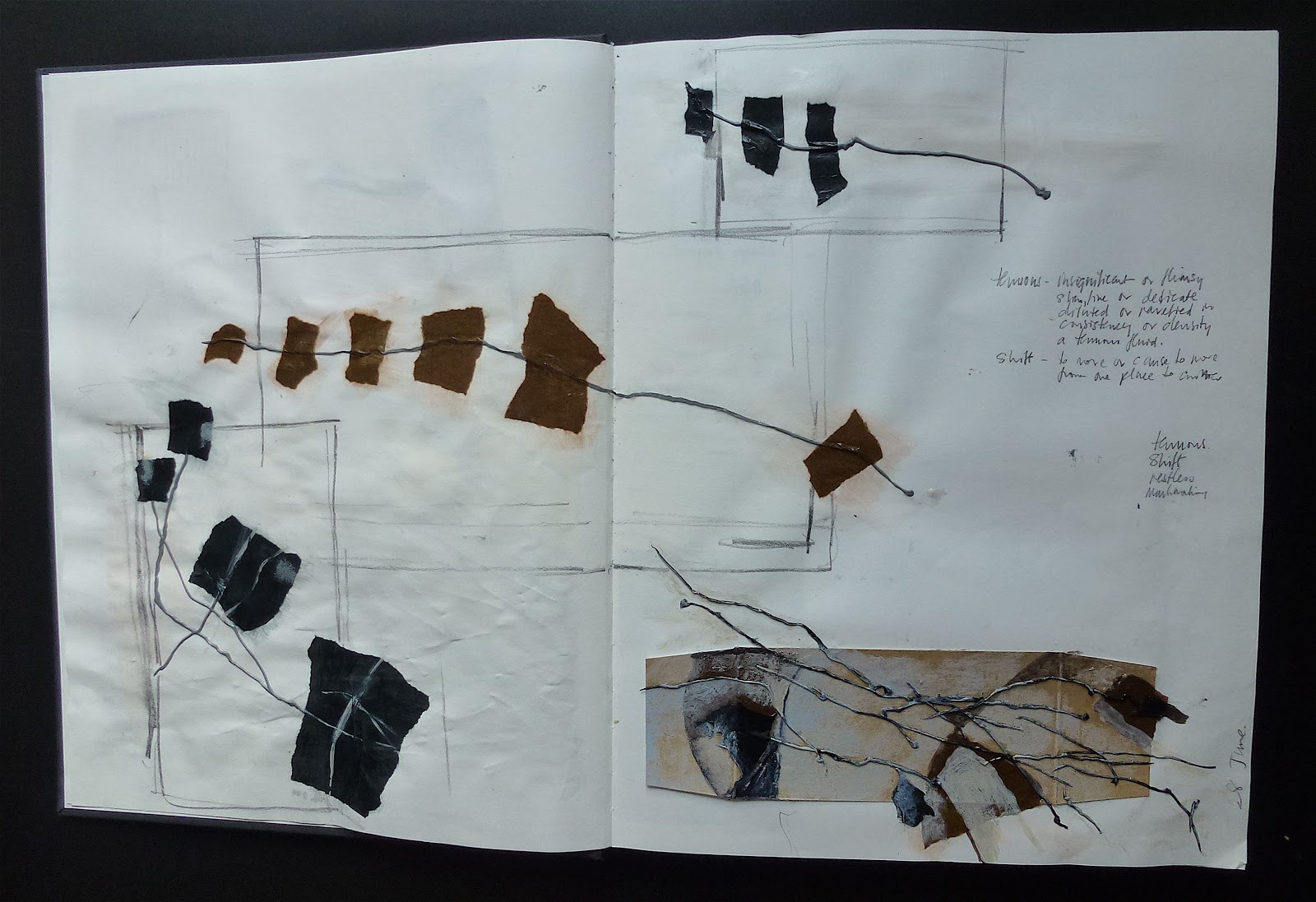
Thinking about combining physical and visual texture..inspired by Marco Gastini's work

Experiments in physical lines by extruding acrylic paint from a syringe

Impasto surfaces using glazed palette knife applied gels.

Exercises: Creating visual texture using dark and light tones


Tuesday, 3 July 2012

Part 1 Physical and Visual texture Research

Comparing Physical/Visual texture


I want to spend some time studying brushmarks. When I paint I tend to get involved with depiction paying little regard to the marks I am making and lack confidence or a visual vocabulary of marks. In short I’ve not found much of a style and would like to work toward that on this course.
I think I would liketo make marks that are individually meaningful (performing some action?) rather than implying atmosphere such as in divisionism and pointillism. The futurists used brushmarks to express movement but their marks were edge to edge often given a decorative surface. Turner or Tobey also used marks to create atmosphere.
Some artists like Giacometti, De Kooning, Debuffet  draw with paint whilst Kandinsky 1910-14 or Bacon apply brushmarks on a ground as pure expression of content. Difficult to sort out or express what I mean exactly.

Pre-renaissance paintings on panels incorporated stucco in decorative area such as Haloes, patterns on clothes, parts of architecture. Some areas are raised some embossed particularly into gold using tools.


4 works employing paint in varying thickness and to different effect. The delicious smooth painting of Vermeer expresses texture in a purely visual way whereas Freud uses paint both physically and visually with ambivalence.


Bacon…… analysis of brushmarks


Whilst Bacon has been criticized for not evolving a variety of subjects and compositions, his work is quite unique and expresses both personal and universal themes such as isolation and instability in relationships. Like Van Gogh he stands alone in a style very much his own that has never dared to be emulated. His broken brushstrokes created by dry paint and large brushes skim the large blocks of flat colour with stark contrast. The rooms/stage sets that the figures inhabit are static and inanimate while the ethereal figures are contorted fragmented characters in states of transition. The distortion of the figures does not beg too much analysis as to quite how the form works, somehow one just accepts their form, in part because their positions are expressive in some way. It is not a world I know but I can read them and comprehend the anguish. I suppose too that cinema has prepared us for his imagery like the space frames and light bulbs whilst an increasingly familiarity with our visceral and organic selves is here reflected.


Friday, 29 June 2012

Part 1 Physical texture. Experimenting with techniques


Part 1 Physical and visual texture -physical texture


Physical texture.....thoughts

It's good to be mucking about experimenting without the pressure of coming up with anything particularly worthy, though I guess that I shall have to face that before too long. I'm working through Part 1 in more depth than the course appears to require. I didn't train as a painter and have always felt that my application of paint, brushstrokes etc has been very wanting I've been more concerned with visual texture and for the most part representation. It was tempting but scarey to start with Appel/Jorn style impasto work at the outset so decided to be more thorough skipping medieval embossed technique (may come back to it) and began my studies at the 15C. The Pollaiolo's finely modeled raised hair knocked me out when I saw it here in Milan 27 years ago and it has been good to study my all time hot favourite Rembrandt's work a little more.

Whilst I love the fluidity and sqigginess of Soutine and of course the wax laden paintings of Van Gogh I do have difficulty appreciating some of Auerbach, Asgar Jorn Karel Appel, Leon Kossoff. To date I find the splurge of emotion raw and crude but I'm trying to keep an open mind. Today I started a painting of a sardine in oils aware that it is a good subject for water colour. I am trying to use plenty of paint building areas of impasto but it doesn't come naturally to me. I'm disappointed so far with the 'dry' look....  I am hoping to make the image quite oily and wet looking. Glazing when dry may help that along.